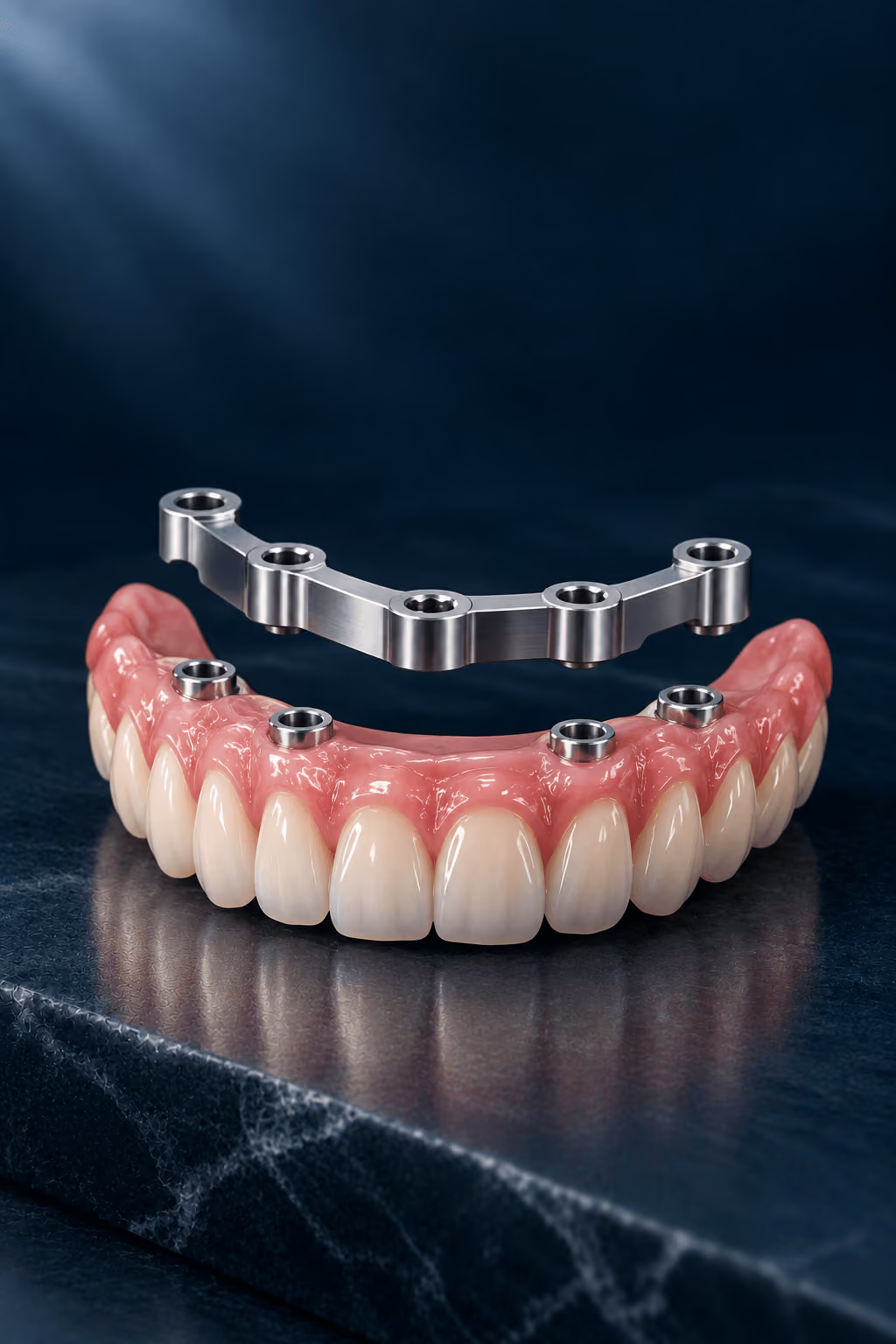
Advanced CAD/CAM-milled bar overdentures combining precision titanium frameworks, Locator attachments, and premium prosthetic teeth.
Get Started
15–18 business days
Available — confirm case requirements
Available — confirm required files
Viva Dental Lab provides CAD/CAM-milled bar overdentures for implant-supported cases requiring a precisely fabricated bar framework and removable overdenture. The catalog service includes four Locator abutments with complete Locator attachments, a CAD/CAM-milled titanium bar, and a final overdenture with premium denture teeth.
Digital fabrication provides a controlled approach to bar design and manufacturing while maintaining the removable prosthetic component required for the final restoration.
Bar overdenture cases require accurate implant positioning, component selection, framework design, and prosthetic integration. Our CAD/CAM workflow provides controlled digital design followed by precision manufacturing and final quality inspection.
The bar is designed and fabricated through a CAD/CAM workflow. Digital implant records and compatible case data can be incorporated when provided.
The completed bar overdenture is inspected for framework quality, attachment integration, tooth position, occlusion, finishing, and overall fabrication quality.
Do not proceed with final processing until the discrepancy has been evaluated. Depending on the source of the discrepancy, additional clinical or laboratory records may be required. Published workflows describe repeating the impression or rescanning when implant-position accuracy or framework fit is not acceptable.
Verify the proposed tooth arrangement, occlusion, esthetics, and overall prosthetic relationship before the final overdenture is processed. Any required changes should be communicated to the laboratory at the try-in stage so they can be incorporated before final fabrication.
Evaluate the framework's seating and fit on the implant or abutment positions. A single-screw or comparable verification procedure may be used to assess passive fit, with radiographic verification when the implant-bar interface cannot be directly visualized.
The bar must seat accurately on the implant or abutment positions before the denture is processed around it. Clinical verification can identify discrepancies in fit before the definitive prosthesis is completed, reducing the risk of carrying an inaccurate framework relationship into the final overdenture.
An accurate maxillomandibular relationship is needed to position the denture teeth correctly relative to the opposing arch and implant-supported framework. Depending on the case, this can include a bite registration, wax rim, or other jaw-relation record suitable for mounting and tooth setup.
Yes. CAD/CAM bar overdentures can be produced using digital implant and prosthetic records. Digital workflows may incorporate intraoral scans, laboratory scans, and CAD/CAM design data. Implant-position accuracy should still be verified before finalizing the bar design.
Provide accurate implant or abutment information along with the records needed to reproduce the implant positions and prosthetic relationship. Depending on the workflow, this may include implant-level impressions or digital scan data, opposing-arch records, and the appropriate bite or jaw-relation records. Accurate implant-position records are particularly important when designing a milled bar.